

The sensor-based Internet of Things is arriving in people's everyday lives. Its growing adoption brings user-friendly solutions and data analytics into focus. Supply shortages are slowing development.
Schimberg and Berlin, 8 December 2021: Alpha-Omega Technology GmbH & Co. KG is an expert in IoT infrastructures and operates the largest online shop for LPWAN products in the German-speaking region. The company sees three trends for the sensor-based IoT in the coming year: CO2 sensors are being used more and more, because they can make an important contribution to current challenges such as climate protection and infection control. This brings IoT into the everyday lives of the general public. A combination of different radio technologies such as LoRaWAN and NB-IoT makes it possible to build networks for numerous use cases. As more and more sensors capture more and more data in more and more areas of life, topics such as user-friendly platforms and data analytics come into focus. The current chip shortage is driving up prices and could slow the spread of IoT. iot-shop.de is therefore expanding its warehouse capacity.
Interest in radio standards for data communication in the Internet of Things (IoT) has been growing for years. Private energy consumption is to be analysed and reduced in order to meet climate targets. As a result, municipal utilities and housing companies are increasingly using smart meters. Commerce and industry are also switching to smart metering, regardless of legal requirements. But beyond energy management, too, the sensor-based IoT is winning more and more friends.
Trend 1: LPWAN sensors support health and climate protection
The sensor-based IoT is increasingly being used for health and climate protection measures and is thus becoming part of everyday life. With the coronavirus pandemic and the SARS-CoV-2 occupational safety rules, for example, the topic of air quality has moved into the awareness of the general public. Since last summer, employers have been required to check air quality by measuring CO2, because the oxygen level affects whether people become infected with influenza or Covid-19. Sensors therefore monitor the air in classrooms, open-plan offices or production facilities and report when defined limits are reached. According to the German Environment Agency, concentrations of more than 1,000 ppm CO2 in indoor air are to be treated as conspicuous, and from 2,000 ppm the value is considered unacceptable. Many areas of our society, such as hospitality and culture, remain open despite high infection figures. The number of people in an enclosed space has a direct influence on the risk of infection. Implementing the requirements for infection control requires additional staff for entrance checks and is cost-intensive. LoRaWAN can help without collecting personal data: infrared light barriers and people counters provide anonymous information on the occupancy of shops, restaurants or meeting rooms. A sensor-based IoT can also help monitor pollutants in workshops.
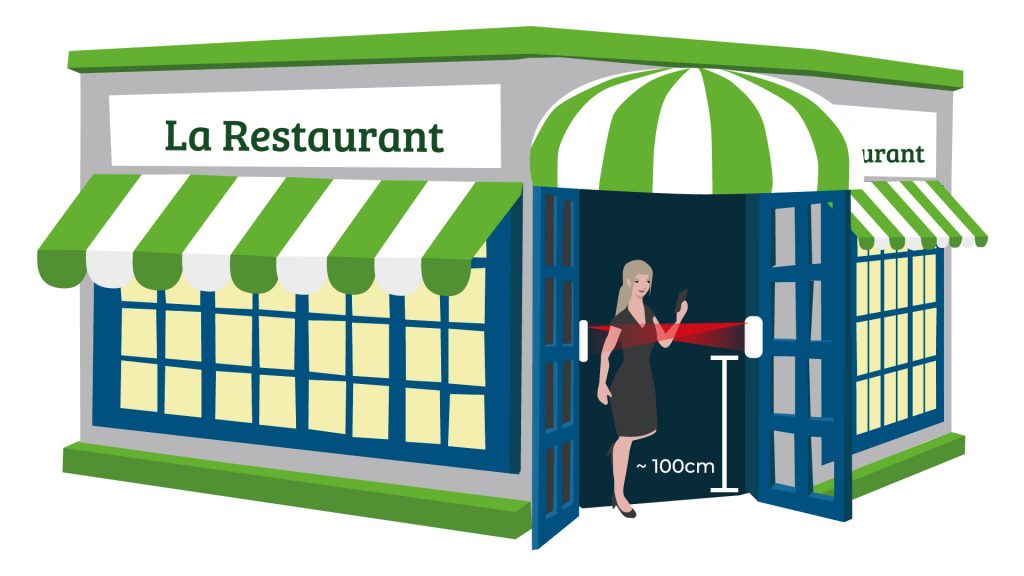 Infrared light barriers and people counters provide anonymous information on the occupancy of shops, restaurants or meeting rooms.
Of course, other values can be measured too, such as temperature, soil moisture or water levels. In this way the sensor-based IoT helps manage the consequences of climate change: if the forest floor is monitored with soil moisture sensors, for example, the data can give early warning of forest fires. And water level sensors will play a role in flood warning systems in future. The use of smart sensors for active climate protection is no longer a thing of the future either, as shown by innovative climate protection projects such as "Project Carbdown" by the Carbon Drawdown Initiative. The initiators want to capture CO2 on arable land using rock dust. A sensor-based LoRaWAN IoT measures the absorbed CO2, with sensors capturing the data underground at various soil depths.
Trend 2: combining radio standards
To transmit the measured values to a server for further evaluation in compliance with data protection rules, Low Power Wide Area Network (LPWAN) radio standards such as Long Range Wide Area Network (LoRaWAN) or Narrowband IoT (NB-IoT) are suitable. They can transmit small amounts of data over long distances with low power consumption. The combination of several LPWAN technologies is the trend: until now, the focus has mostly been on which radio standard is the best for a sensor-based IoT. But every solution has advantages and disadvantages. Those who know the differences and combine them cleverly can get more out of their networked sensors and create potential for savings, maintenance or hazard prevention. Applications range from facility management and smart farming to the smart city. One example: NB-IoT has similar properties to LoRaWAN, but there is one important difference. NB-IoT uses the existing network of the large German mobile operators and can therefore be operated almost anywhere. NB-IoT can thus step in at locations that LoRaWAN does not cover because installing additional gateways is not practical, for example in rough terrain, in remote properties or behind very thick basement walls.
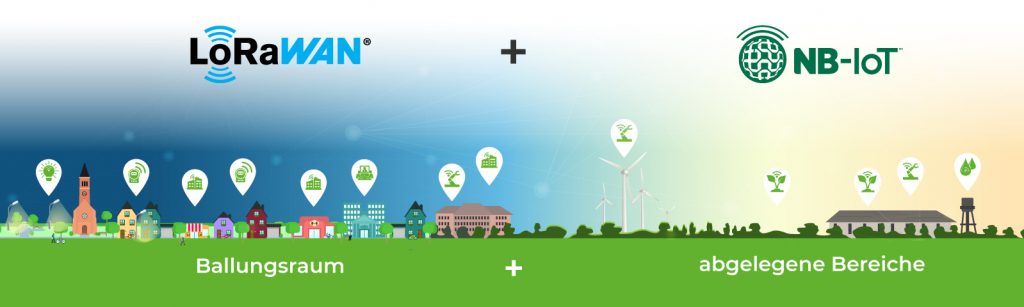 Those who use NB-IoT can, for example, integrate remote properties into a LoRaWAN network.
Trend 3: tapping data potential with data analytics
As the sensor-based IoT spreads, so does interest in solutions for analysing the collected data, visualising it dynamically and storing it long term. In addition to easy-to-use platforms such as Datacake, where dashboards can be created without programming, more and more specialised solutions will be offered in future that are particularly good at one specific task, such as controlling street lighting or facility management.
Business analytics services such as Microsoft Power BI are also seeing rising demand. They help to process large volumes of complex data from different sources automatically. The large providers offer powerful services in data analytics and data insights. The network server "The Things Stack" leads users directly to Amazon Web Services (AWS), where "The Things Stack AWS Launcher" offers a simple solution. Anyone who wants professional business applications that integrate into the existing software infrastructure will take a look at the Microsoft cloud.
The IoT edge platform BITMOTECOsystem , with its large number of interfaces, internal database, analysis tools and visualisation software, enables even companies with little know-how to use IoT effectively and makes sensor data available throughout the company network. "Integrating sensors and easy-to-use IoT platforms such as BITMOTECOsystem into the ongoing production process of medium-sized companies opens up enormous potential," says Jan Bose, managing director of Alpha-Omega Technology GmbH. "The platforms can take on a great many tasks such as fill level monitoring and raise an alarm in time to avoid production downtime. Over time, data can be collected as well. On that basis, the platform can send an automatic message to purchasing, either via an alarm when a limit is exceeded or based on average consumption, so that purchasing can trigger a new order in time, avoid overstock and save space and resources."
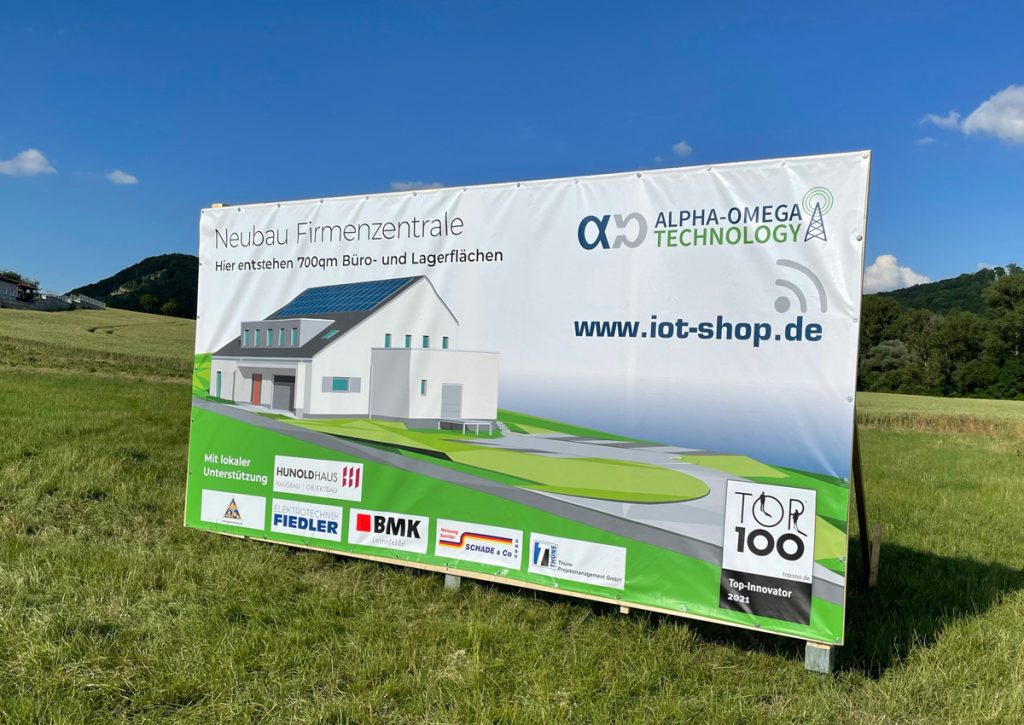 With the construction of a new headquarters in Schimberg, Thuringia, Alpha-Omega Technology is enlarging the iot-shop warehouse and will be better able to respond to shortages in future.
Supply shortages lead to higher prices
The chip shortage will persist in the coming year. It affects not only the automotive industry but also the availability of IoT sensors. The result of the shortages is noticeable price increases. "Supply shortages may continue to occur, as they did in 2021. We are trying to cushion the situation and are in close contact with our customers, for example to recommend alternative products. For time-critical projects we look for solutions and try to show ways forward. With the construction of a new headquarters in Schimberg, Thuringia, we will soon have a significantly larger warehouse for our products and will be able to respond better to shortages in the IoT-Shop in future," says Jan Bose.