



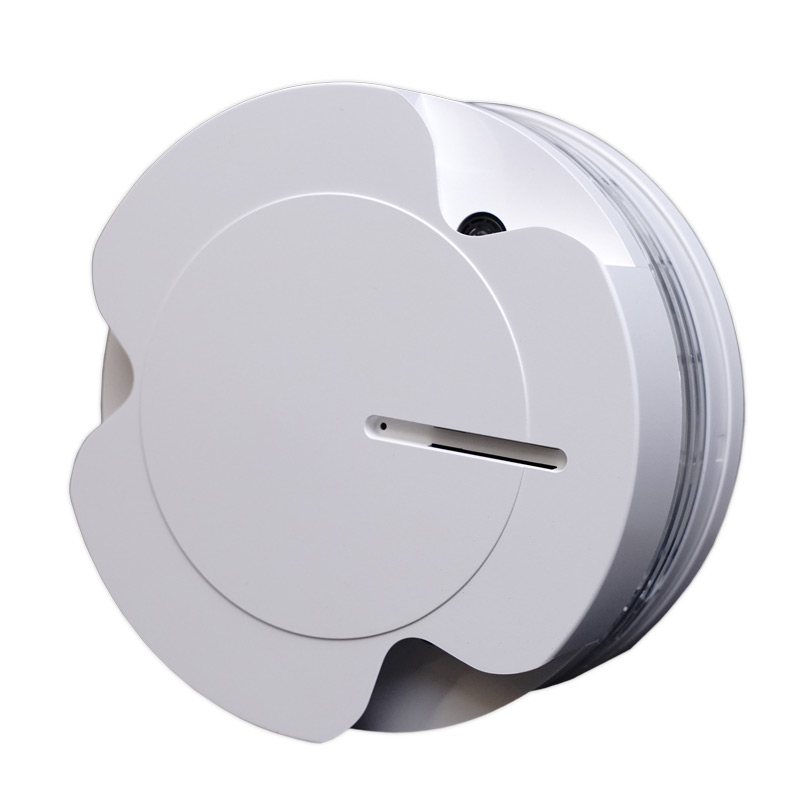



LoRaWAN smoke alarm for housing companies, metering service providers and network operators
The Hager TG563A reports smoke, tampering attempts and soiling via LoRaWAN to your IoT platform. You see the status of your detectors centrally instead of checking flat by flat.
- Remote inspection via LoRaWAN: check readiness, battery, soiling and tampering centrally
- EN 14604, up to 10-year battery (sealed), 85 dB alarm, 5-year warranty
- Network-neutral: works in any LoRaWAN network in the EU868 band, public or private
- Payload decoder freely available on GitHub, data sheet and manual under "Documents"
- End-to-end encrypted, automatic reconnection after network loss
Over 1,000 units in stock. Project quantities on request: info@iot-shop.de or +49 36082 8477-99
The Hager TG563A is a LoRaWAN smoke alarm for buildings with a 5-year warranty. With a battery life of up to 10 years, an audible alarm with a volume of 85 dB, visual warning and integrated self-monitoring, it offers maximum safety and maintenance-free operation. The detector is suitable for professional use in residential buildings, care facilities and public institutions and communicates wirelessly via LoRaWAN. Data transmission is end-to-end encrypted and meets the highest safety standards, including the European product standard for smoke alarms EN 14604:2005/AC:2008. In addition to reliable smoke detection, the device detects tampering attempts, reports soiling and adapts to different environmental conditions. Thanks to simple ceiling or wall mounting, support for remote inspection and automatic reconnection in the event of power loss, the TG563A can be efficiently integrated into existing infrastructures and makes a significant contribution to the digitalization of building security.
New solution for smart buildings: Alpha-Omega Technology and Hager Safety present LoRaWAN smoke alarms
By integrating LoRaWAN technology, the TG563A smoke alarm fits seamlessly into existing IoT infrastructures and opens up new possibilities for remote monitoring and maintenance for building managers and owners.
| Equipment | |
|---|---|
| antenna | internal |
| sensors | smoke, manipulation |
| Communication | |
| frequency | EU868 |
| connectivity | LoRaWAN |
| Power supply | |
| power supply | battery, included, not replaceable |
| Certifications | |
| enclosure protection class | IP30 |
| Others | |
| Brand | Sieben-S |
The TG563A is an optical smoke alarm. An infrared diode emits light into a dark smoke chamber; smoke scatters the light onto the receiver and triggers the alarm. It measures every 10 seconds, more often when smoke is suspected. Chamber fouling and daylight are compensated.
Smoke chamber: fouling every 2 minutes plus continuous check of emitter, receiver and amplifier. Battery: every 26 hours under load. Buzzer: every 7 days during daytime, audible as a short crackle. Surrounding area (ultrasonic) and air inlet (infrared): every 7 days. The manufacturer additionally recommends a monthly test via the button.
An ultrasonic sensor checks for objects closer than 50 cm that could block smoke (shelves, boxes, beams). If 50 cm of clearance is not possible at installation, the detector proposes a shorter test distance (10 to 50 cm) that the installer accepts by pressing the button. An obstacle is reported only after about one month of consecutive detection. Objects closer than 10 cm or sound-absorbing objects cannot be detected by ultrasound.
Yes. An infrared sensor with a light guide checks every 7 days whether the inlet grid is covered, for example by tape, foil or paint. Combined with the ultrasonic check, the detector also notices coverings that do not touch the light guide directly. The fault is shown locally and reported via LoRaWAN.
A short message (5 bytes) with status and temperature once a day, and a long message (35 bytes) once a week with battery voltage, serial number, production and installation date, counters for alarms, tests, faults and mountings, smoke chamber fouling, minimum and maximum temperature and the test distance. Smoke, low battery, defects, obstacles and covering are sent immediately. All messages use fPort 1; the manufacturer's payload decoder is available on GitHub.
Event messages are sent without acknowledgement and without retries. If a message is lost, the status is included in the next message. The TG563A warns locally by sound and light; the radio message serves remote monitoring and maintenance. According to the manufacturer, the detector must not be used in a fire alarm system.
Ten commands are available on fPort 1: uplink interval from 1 to 48 hours (default 24 hours), weekly long message on or off or requested once, immediate events for smoke, obstruction and hardware faults individually on or off, and a new join with a delay of 0 to 15 days. Shorter intervals use more battery; with too many requests the detector switches to a saving mode.
Via OTAA, as soon as it is placed on the mounting plate and all self-tests have passed. It tries five times within about one minute and then once a day. Smoke warning works without a network. Without a downlink for 7 days it sends confirmed messages; after 40 days without a downlink it resets its radio settings and rejoins. A downlink about once a month keeps the connection stable.
The sealed 3 V lithium battery lasts 10 years with typical use (daily message, weekly long message, monthly downlink and test). It cannot be replaced; after 10 years the detector is replaced. After a low-battery warning it continues to work normally for at least 30 days and can still sound an alarm for 240 seconds.
Preferably in the centre of the ceiling, alternatively on the wall 30 to 50 cm below the ceiling, using the supplied mounting plate, screws and dowels. Keep at least 50 cm from obstacles and 1 m from ventilation openings; not in bathrooms, kitchens, dusty rooms or directly on metal. Room height up to 6 m, coverage up to 60 m², operation at +10 to +40 °C. The mounting recommendations comply with DIN 14676:2019-02.