



LPWAN technologies such as LoRaWAN and NB-IoT can be combined sensibly to unlock potential in digital metering.
In addition to municipal utilities and housing companies, commerce and industry are increasingly switching to digital meter reading. Apart from the legal obligation under the German Metering Point Operation Act (MsbG), modern metering equipment and smart metering systems are needed to collect and analyse consumption data and to display and control consumption flows transparently. Suitable radio standards are required to transmit the growing volumes of decentrally collected data to the corresponding platforms or back-end systems. For communicating the small data packets typically generated by sensors or meters, there are currently several solutions: the most important technologies on the market are wireless and wired M-Bus, LoRaWAN (Long Range Wide Area Network) and NB-IoT (Narrowband IoT). "Until now, the focus has mostly been on which technology is the best and why. Yet each solution has its own advantages and disadvantages. So why not combine the advantages of different network solutions?" asks Jan Bose, managing director of Alpha-Omega Technology GmbH & Co. KG. The technology company develops IoT applications based on low-power networks such as LoRaWAN and implements IoT networks for municipalities and companies.
Combining radio standards to advantage
Thomas Nickel explains the potential that can unfold when radio standards cooperate and, used in parallel, bring their respective advantages to bear in an IoT, using the example of the two compatible network solutions LoRaWAN and NB-IoT. He is Area Manager DACH at Elvaco AB, a Swedish solution provider for energy metering. "What both standards have in common is that they belong to the group of Low Power Wide Area (LPWA) technologies, which are characterised by low costs, low energy consumption and excellent building penetration. This makes both solutions well suited to the requirements of remote meter reading and smart metering," says Thomas Nickel. Users who intelligently combine the differences between the two technologies can therefore get even more out of their IoT infrastructure.
 Because NB-IoT uses the existing telecommunications network, it can be operated almost anywhere and is therefore suitable as a complement to an existing LoRaWAN network (graphic: Alpha-Omega Technology GmbH & Co. KG)
LoRaWAN: licence-free radio, protecting sensitive data
Compared with other radio technologies such as M-Bus or NB-IoT, users of LoRaWAN can decide whether to choose an existing network operator or to build the network infrastructure themselves. This freedom of choice and the potential independence from a network operator make the solution suitable for locally limited projects. M-Bus users have to build their own infrastructure, while NB-IoT depends on external providers. In addition, users of a LoRaWAN network retain full control over their data, so that sensitive information is not processed by third parties, as Jan Bose explains: "A municipal utility, for example, bears great responsibility for data security and therefore for the privacy of its citizens. LoRaWAN offers a secure basis here, because the protocol works with two-level symmetric encryption and the key is never transmitted over the air."
NB-IoT as a complementary technology
With the NB-IoT radio standard, users do not have to set up additional LoRaWAN gateways. Thomas Nickel: "For a municipal utility, for example, this offers a cost-effective way of integrating a property far away from the town into the IoT.
LoRaWAN and NB-IoT
LoRaWAN stands for Long Range Wide Area Network. The licence-free
radio standard transmits measurement and sensor data
continuously, even over long distances. LoRaWAN sensors
are simple in design. This makes them inexpensive and
flexible to use, with long battery lives of five to
sometimes even more than ten years.
NB-IoT uses the existing network of the large German mobile operators
and can therefore be operated almost anywhere.
NB-IoT can thus complement the network at locations
where LoRaWAN is not available.
On average, up to five percent of meters in metering are outside the existing radio range. Reaching these last few percent causes comparatively high costs for operators. The combined use of LoRaWAN and NB-IoT solves this problem."
One example is a railway station in a city centre whose basement rooms are to be integrated into an existing LoRaWAN IoT. If the walls are heavily shielded, LoRaWAN may not be able to penetrate them completely. In both cases an NB-IoT module can provide a remedy alongside LoRaWAN. The municipal utility uses the existing NB-IoT infrastructure of the large providers, with which contracts usually already exist, and does not have to install any additional gateways.
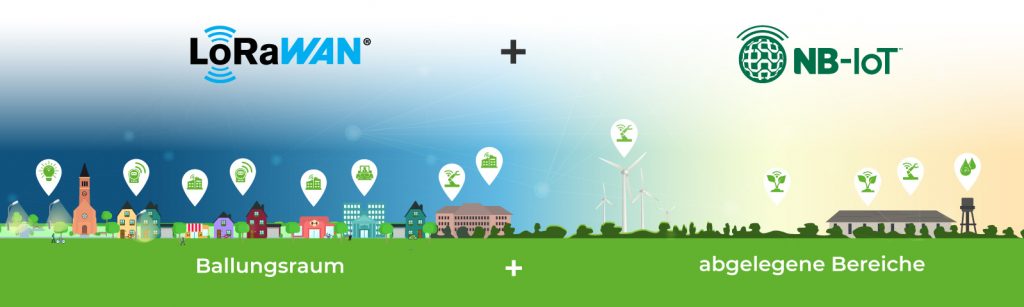 The use of NB-IoT makes it possible to integrate even remote properties into a LoRaWAN network.
(graphic: Alpha-Omega GmbH & Co. KG)
A wide range of applications
In larger residential buildings or in complexes such as office buildings or shopping centres, a sensor-based IoT network can be used to offer extended metering services and to unlock energy efficiency potential.
According to the two experts, however, the applications of LoRaWAN and NB-IoT go far beyond energy saving and include smart buildings and smart cities. "In addition to metering technology for heat, electricity and water, many other sensor-equipped devices in residential buildings or production facilities can be integrated into modern remote reading systems. Networked heat meters, for example, provide energy companies with information on volume, flow rate and supply and return temperatures. On the basis of the data obtained, network management can be optimised and predictive maintenance implemented," the Alpha-Omega Technology managing director outlines further use cases.
"Another example is smoke detectors or temperature and humidity sensors in public properties, residential and commercial buildings, for instance to counteract mould growth. Monitoring by IoT sensors can ensure that a situation endangering the building or people's health through moisture or mould does not arise in the first place," adds Thomas Nickel. Further examples are services for intelligent sensor-based street lighting, parking management or solutions to improve a municipality's own processes, for example in waste disposal, winter road maintenance and many other tasks.
This article was published in 50,2 Magazin für intelligente Stromnetze, issue 02/2021 .