


Martinfeld / Schimberg. From 4 to 6 October 2017, the first severe storm of the season swept across Germany. Its fringes reached as far as Martinfeld in Thuringia. In this village, Alpha-Omega Technology GmbH und Co. KG operates, alongside a number of other LPWAN-based sensors , a so-called Plug&Sense Smart Agriculture sensor from Libelium (see iot-shop.de). This sensor is located at 52°17’20.81‘‘ N, 10°10’59.03‘‘ E at 278 m above sea level. Its IP67 housing and its self-sufficient power supply from environmentally friendly solar cells make it the tool of choice for measuring a wide variety of environmental parameters. In the present configuration, the sensor transmitted data for the following parameters every 10 minutes:
Air pressure, wind speed, wind direction, precipitation intensity, temperature and humidity
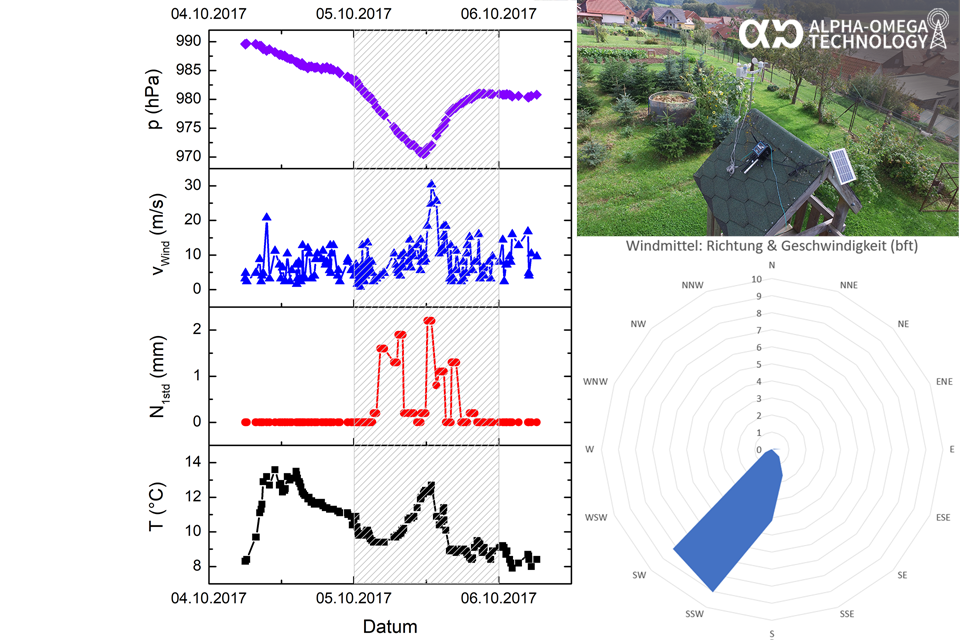
The first five parameters are shown for the period from 4 October 2017, 6 a.m., to 6 October 2017, 6 a.m. The highlighted area marks a 24-hour period between 5 October 2017, 0:00, and 6 October 2017, 23:59. During this time, maximum values were observed for air pressure, wind speed and precipitation intensity. The first chart from the top shows the air pressure p for these periods. The expected sharp drop in air pressure is clearly visible: the air pressure in Martinfeld reached its minimum of 970 hPa on 5 October 2017 at noon. At about the same time, the highest wind speeds of 30.4 m/s were measured, as the second chart clearly shows. They thus almost reached hurricane force, which begins at 32.7 m/s. The third chart, which shows the hourly precipitation intensities, makes clear that this reading was also significantly elevated during the storm. The fourth chart shows the temperature in the periods mentioned. It rises noticeably, especially at the peak of the storm, and also reaches its maximum on 5 October 2017 at noon. The fifth chart shows the values for wind direction and speed averaged over the period from 5 October 2017, 0:00, to 6 October 2017, 23:59. On average, the wind during this period came from SW to SSW and reached speeds well above 8 Bft.
The powerful, energy-efficient and low-cost LPWAN technology LoRaWAN was used to transmit the data. The components, consisting of LoRaWAN sensors from the manufacturer Libelium, LoRaWAN gateways from the manufacturer Kerlink and the ELEMENT IoT platform from ZENNER IoT Solutions , were assembled and installed by Alpha-Omega Technology to realise this end-to-end IoT solution. AOT in turn fully supports its customers in planning, procuring and commissioning such wireless sensor networks.
Such solutions are of interest to customers from the insurance industry, agriculture and other fields in which precise measurements and forecasts of environmental parameters are of decisive importance. With us, they get everything from a single source.
Interested in this or another of our solutions? Write to us, we will be happy to prepare an individual offer for you.