


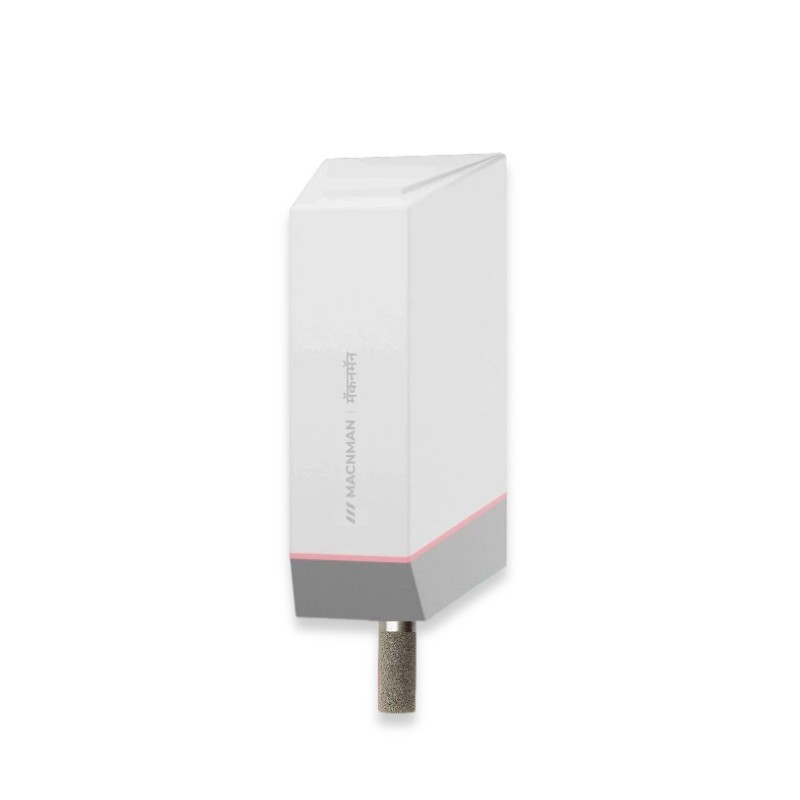
Macnman 820 MacSync L CO2 X1
This product is no longer available.
incl. 19.0% VAT plus Shipping costs
| Equipment | |
|---|---|
| antenna | internal |
| sensors | CO2 |
| Communication | |
| connectivity | LoRaWAN |
| frequency | EU868 |
| activation | OTAA |
| interfaces | App, Bluetooth, Downlink |
| Power supply | |
| power supply | power supply, battery, included, not replaceable |
| battery details | Lithium-Thionylchlorid, nicht aufladbar |
| General | |
| variants | Messbereich: 400-2000 ppm or Messbereich: 400-5000 ppm |
| variants | Batterie or Netzteil |
| Certifications | |
| enclosure protection class | IP65 |
| Others | |
| Brand | Macnman |
The MacSync L CO2 sensor series is available in two primary measurement ranges. Model X1 provides a standard range of 400 to 2,000 ppm, while Model X2 offers an extended range of 400 to 5,000 ppm for industrial or high-concentration monitoring.
The primary difference lies in the power source. The BO (Battery Operated) variants feature an integrated 19 Ah Lithium Thionyl Chloride (Li-SOCl2) battery for remote monitoring. The PO (Power Operated) variants are designed for external power (9–36 V DC) and include an external probe.
Battery life for battery-operated models depends on the reporting interval. Under standard operating conditions, the integrated battery lasts approximately 2.5 years with a 15-minute reporting interval and can exceed 4 years when using a 60-minute reporting interval.
The devices are designed for flexible deployment and support both wall-mounted and pole-mounted installations, making them suitable for environmental monitoring in smart infrastructure or industrial settings.
No, the sensors come factory-calibrated and ready for use. Power-operated variants also feature a fast response time (T90) of 60 seconds or less and an internal multi-color LED for status indication.
Yes, the devices support configurable gas detection thresholds. You can set specific alerts and choose between periodic, event-based, or hybrid data reporting modes to match your monitoring requirements.
The sampling interval is fully configurable, allowing you to set data reporting anywhere from every 1 minute to once every 24 hours, depending on whether you need real-time visibility or long-term energy efficiency.