


![youtube - [Video]](/web/image/product.image/2698/image_128/youtube%20-%20%5BVideo%5D?unique=b2aadae)
MClimate LW-CO2-E-INK-01-BI CO2 DISPLAY LoRaWAN Air Quality Sensor
SKU |
MCL-LW-CO2-E-INK-01-BI |
incl. 19.0% VAT plus Shipping costs
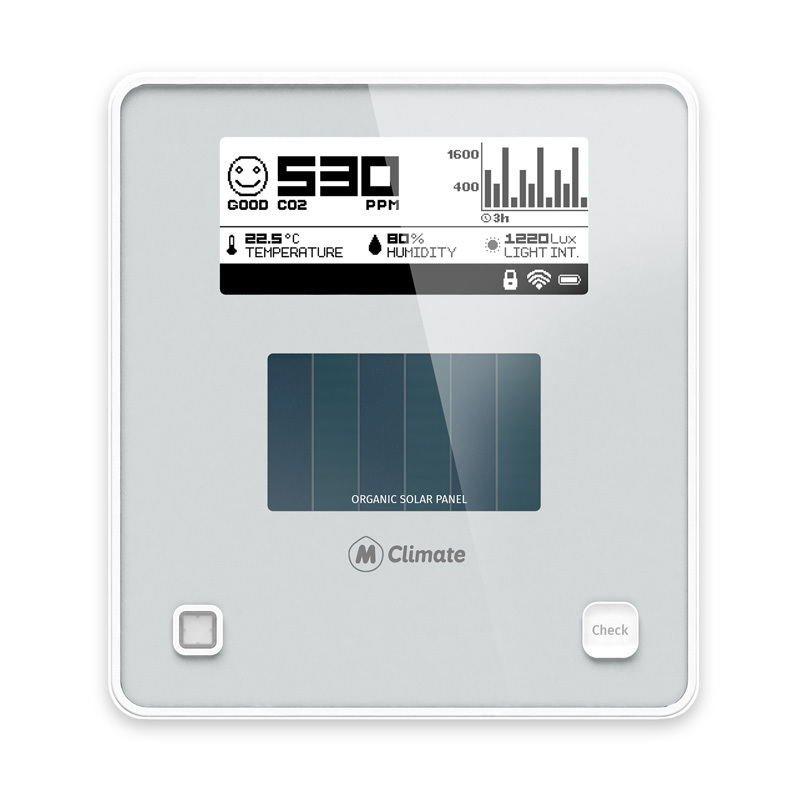
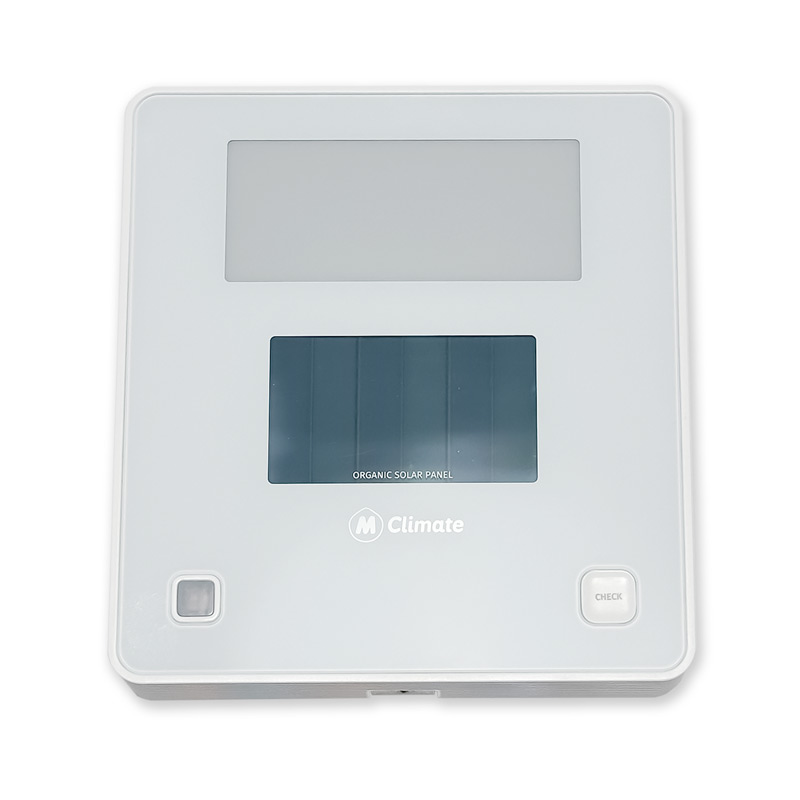
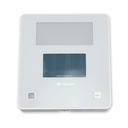
Der MClimate CO2 Display ist ein eigenständiger Raumluftqualitätssensor mit 2,9" E-Ink-Display. Das Gerät erfasst CO₂-Konzentration (NDIR-Sensor), Temperatur, Luftfeuchtigkeit und Lichtstärke und verfügt zusätzlich über einen Bewegungssensor. Auf dem Display sieht der Nutzer sowohl den aktuellen CO₂-Wert als auch historische Verläufe. Die Energieversorgung kombiniert ein organisches Solarpanel mit 2× AA-Lithiumbatterien (Energizer Ultimate Lithium). Das garantiert eine Laufzeit von über 10 Jahren – unabhängig von den Lichtverhältnissen am Montageort. In gut beleuchteten Räumen verlängert das Solarpanel die Laufzeit darüber hinaus erheblich.
| Equipment | |
|---|---|
| sensors | ambient temperature, air humidity, light, presence / attendance, CO2 |
| Communication | |
| frequency | EU868 |
| connectivity | LoRaWAN |
| Power supply | |
| power supply | Solar, battery, included, replaceable, USB |
| battery details | AA, Lithium-Thionylchlorid, nicht aufladbar |
| number of batteries | 4 |
| Others | |
| Brand | MClimate |
PIR motion detector or ToF sensor

PIR motion detector
How a PIR motion detector works:
The PIR motion detectors (passive infrared sensors) are named after pyroelectricity, whereby a change in temperature leads to a measurable change in electrical voltage. Every living organism emits infrared radiation. A change in the heat source registers that something is moving and, depending on the design, in which direction it is moving. PIR motion detectors are therefore often used as light motion detectors, whereby the light is activated when a PIR motion detector registers movement.
Applications of a PIR motion detector:
PIR motion detectors are key instruments in smart facility management. They regulate the motion detector light in offices and public spaces, reduce energy waste and increase comfort. At the same time, they detect unauthorized access, contribute to security and enable efficient lighting control as part of smart facility management.
ToF sensors
How a ToF sensor works:
The ToF sensors are named after the term Time-of-Flight, which also describes exactly what happens with these IoT sensors. They measure the time it takes for the emitted light to be reflected and to arrive again. Depending on the model, several fields are used to register not only whether something is in the entire area, but also the differences within this area. This can be very helpful in applications such as offices or business premises where user behavior is also relevant. Together with learned patterns through AI, ToF sensors can be the basis for many intelligent applications.
Applications of a ToF sensor:
ToF sensors are valuable tools in smart facility management. They enable the precise recording of room utilization in offices and event rooms as well as people counting with directions of movement. As effective people counters, ToF sensors record the presence of people in real time and enable demand-oriented use of the premises as part of smart facility management.

The device features a comprehensive suite of sensors including an NDIR CO2 sensor, temperature, humidity, light intensity (LUX), and motion detection (PIR). This data is visualized on a 2.9-inch e-ink screen.
The sensor is ideal for Smart Buildings, Residential buildings, Commercial buildings, and Hotels. It can be installed using screws and dowels, double-sided tape, or a specialized anti-theft bracket with a secure screw for tamper prevention.
The device offers triple power redundancy: it can be powered via its integrated solar lithium-ion capacitor, 4xAA 1.5VDC batteries, or a standard USB-C connection.
Under solar power, the device can run indefinitely. When using 4xAA batteries, it can last over 10 years depending on the environment and configuration. If left in total darkness, the device will continue to operate for up to 14 days.
The device utilizes a professional-grade NDIR CO2 sensor with a measurement range of 0 to 5000ppm and an accuracy of ±(30ppm + 3% of the reading).
The PIR motion sensor has a viewing angle of 100° horizontally and 90° vertically. The light sensor (LUX) has a range of 0 to 10,000 LUX with a resolution of 1 LUX.
The sensor is designed to operate in temperatures ranging from 0° to +50°C and humidity levels between 0-80% RH, provided there is no condensation.