


Ice monitoring in the winter service of the city of Gütersloh and the district of Hof
Two municipalities are replacing nighttime inspection drives with LoRaWAN sensors that measure the temperature of the road surface. In both projects, we have taken over the procurement and logistics of the sensors, from sampling to pre-configuration to site-specific commissioning.
Why the bridge freezes and the road next to it remains dry.
A clear frost night from 6 PM to 6 AM in timelapse, with the values reported by the sensor hourly. Press play or swipe the scene with your finger.
Initial situation: Control drives in the middle of the night
Between November and March, in most municipalities, a staff member from the public works department drives a fixed route every night to check whether snow needs to be cleared or salt needs to be spread. This inspection drive incurs costs for personnel at inconvenient times, as well as for vehicles and fuel—regardless of whether any action is actually taken in the end. On many nights, it was for nothing.
She also has a weakness that cannot be fixed with more discipline: she only sees the spot where she currently is. A bridge at the edge of town is several Kelvin lower than the town's thoroughfare on clear nights because it is freely surrounded from below and radiates its heat unhindered. Whoever approaches this bridge as the last point of the route learns last about the most dangerous spot in the municipality.
In the absence of reliable measurements, caution prevails, and it is better to spread too much. This is understandable, but it costs de-icing agents, burdens soils and waters, and damages surfaces and structures. At the same time, the responsibility for traffic safety remains with the municipality — and in case of disputes, what is documented counts, not what someone saw at night.
Why LoRaWAN sensors?
A sensor mast on a bridge at the edge of a town usually has neither a network connection nor a reliable mobile phone signal. This is exactly what LoRaWAN is designed for: the sensors send a few bytes per measurement, can transmit over kilometers and through vegetation to the next gateway, and operate for years on a single battery. A single gateway can cover an entire locality.
The second reason is economic. LoRaWAN is operator-neutral. Once the network is established, it can be used for everything else — the Hof district operates flood early warning systems and monitoring of fire water tanks on the same infrastructure, among other things. The winter service is just one application among many, not a separate system with its own follow-up costs.
The deployed sensors from Decentlab & Voltaic
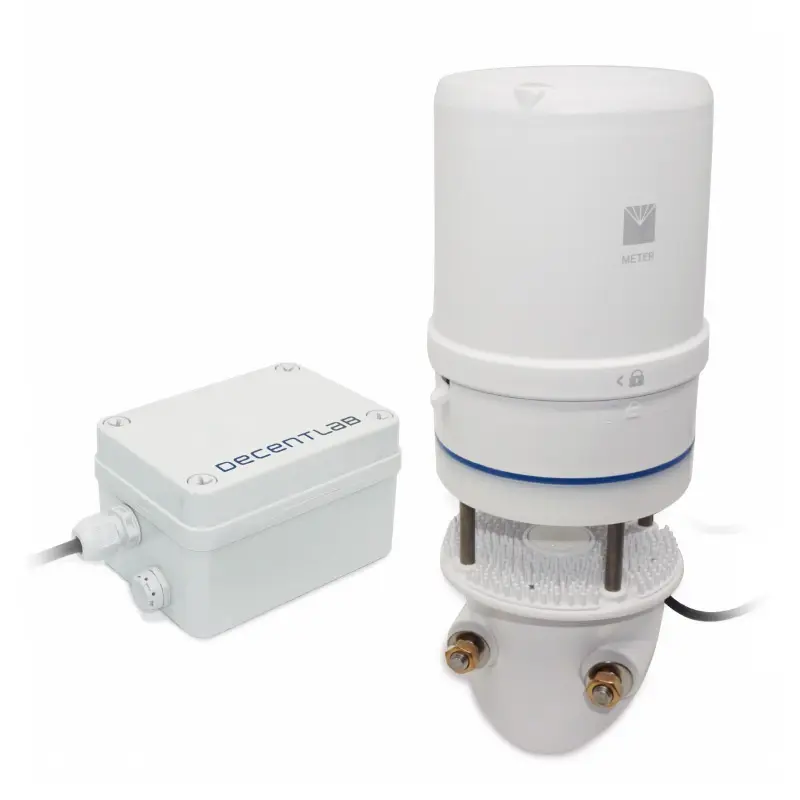
Decentlab DL-ATM41-G2 LoRaWAN Weather Station 11in1
The DL-ATM41-G2 from Decentlab is a comprehensive outdoor weather monitoring device. The LoRaWAN-capable all-in-one weather station features sensors for precipitation, solar radiation, air temperature, relative humidity, indoor temperature, vapor pressure, air pressure, barometric pressure, wind speed and direction, maximum wind speed, tilt sensor, lightning strike count, and average lightning distance. It is powered by two C alkaline batteries and has configurable sampling and upload intervals. With the weather station, you get unattended real-time remote monitoring.
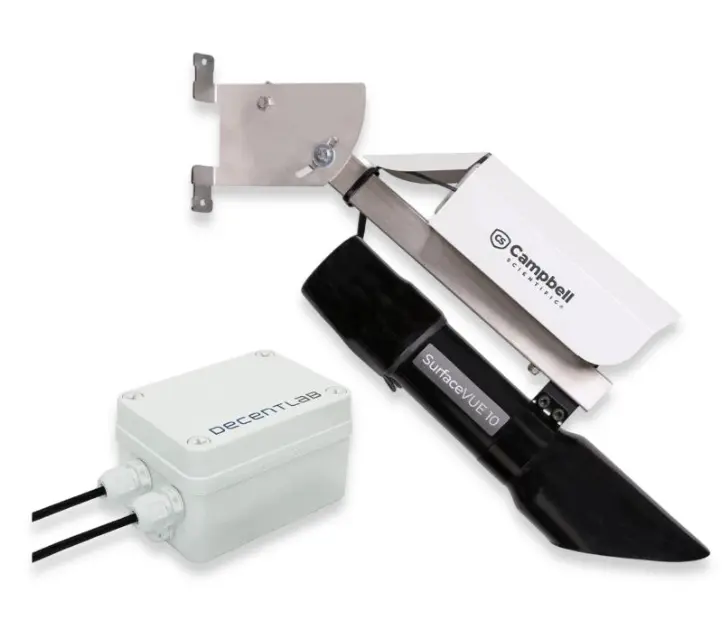
Decentlab DL-SFV-001 Road Condition and Temperature Sensor
The Decentlab DL-SFV is a LoRaWAN-capable, non-invasive sensor for measuring road surface conditions and temperature. It reliably detects whether the roadway is dry, damp, wet, snowy, or icy, and measures the surface temperature with an accuracy of ±0.3 °C. Additionally, the sensor captures air temperature, humidity, and air pressure, and calculates values such as dew point, ground, and wind data. Thanks to its robust IP67 design, multi-year battery life, and easy installation, the DL-SFV sensor enables precise, low-maintenance road monitoring for winter services, traffic safety, and smart city applications.
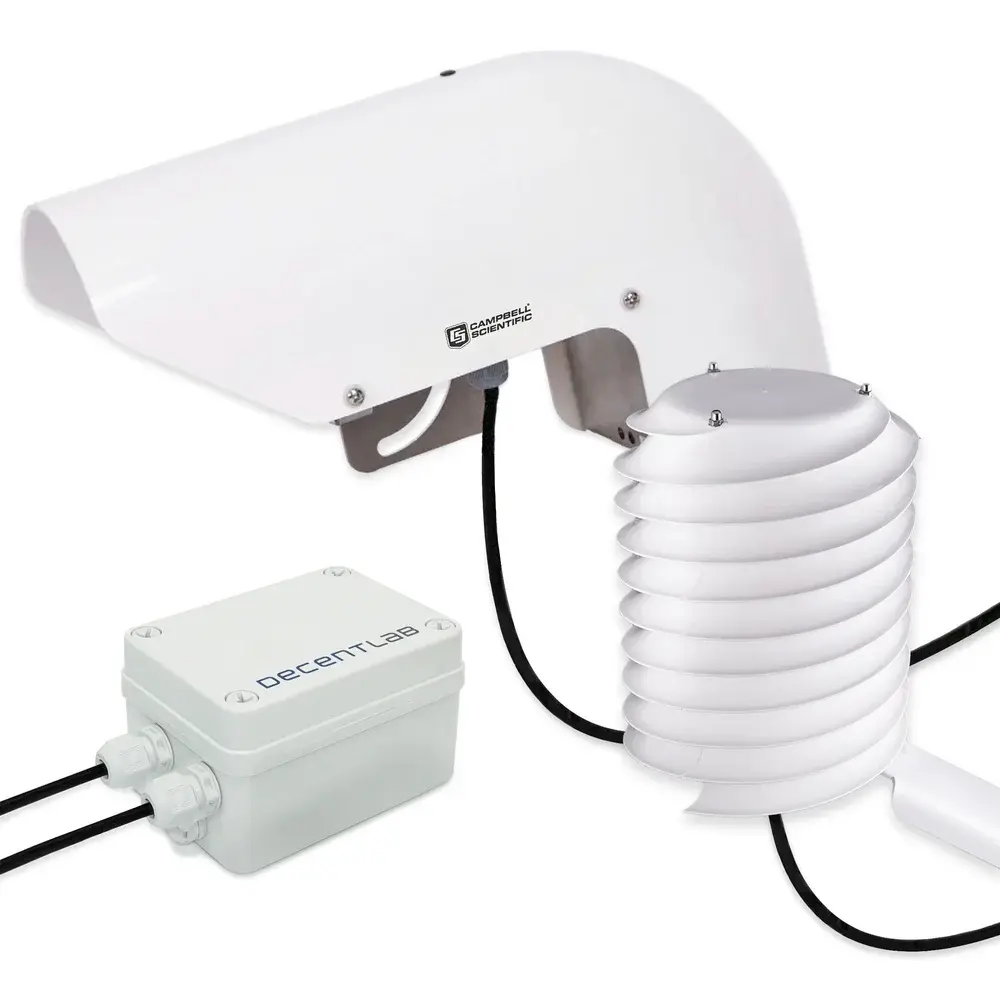
Decentlab DL-CWS2-001 LoRaWAN Winter Service Sensor with Radiation Protection
The Decentlab DL-CWS2 is a precise sensor for winter road management, measuring road surface temperature, air temperature, and humidity with high reliability. Data is transmitted energy-efficiently and securely over long distances via LoRaWAN. With its robust IP67 housing and radiation protection, the sensor is ideally suited for permanent outdoor use. Compared to the DL-CWS, which has temperature and humidity sensors integrated directly into the housing, the DL-CWS2 features an external sensor in a radiation shield. This design allows for particularly stable and accurate measurements under challenging conditions, such as high humidity or when the dew point is exceeded, which is crucial for frost warnings and proactive winter service planning. With its long battery life and straightforward installation, the DL-CWS2 is a reliable solution for RWIS, smart infrastructure, and agricultural applications.
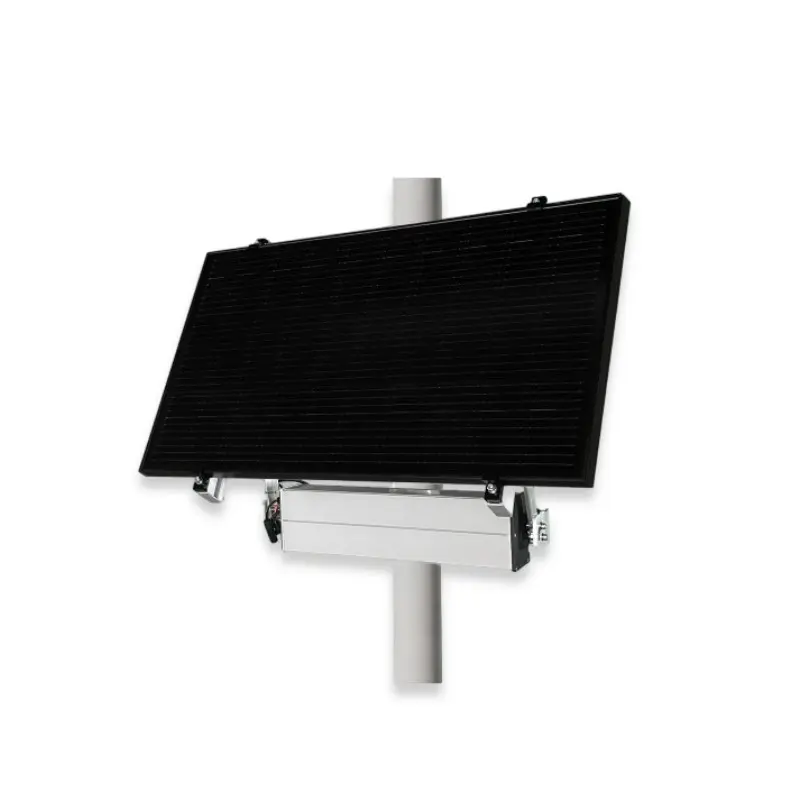
Voltaic Systems K-P151-V107 100 Watt CORE Solar System
The Voltaic K-P151-V107 100 Watt CORE Solar System provides autonomous energy for IoT devices such as LoRaWAN gateways, cameras, or sensors. It combines a 100 W solar panel with a 12 V / 60 Ah LiFePO4 battery and an integrated MPPT charge controller, making it durable, weatherproof, and without the need for an additional housing. Connected devices can be powered directly via USB-C through the 12 V to 5 V USB-C regulator. Ideal for smart cities, surveillance, environmental monitoring, and remote locations.
Sensor-based weather monitoring for urban winter services
The city of Gütersloh permanently monitors the condition of the road surface at selected points in the urban area instead of using random sampling. The sensors are solar-powered and installed on existing light poles as well as on additional poles specifically set up for this purpose; the measurement data is transmitted to the city's data platform. The departments involved are waste management, as well as digitalization and geoinformation.
The city's stated goal: targeted clearing and salting, avoiding unnecessary travel routes and salt applications — this protects the environment and saves costs. The project is being implemented in phases, with additional locations being added gradually. Write something ...
Dew Point Sensing for Smarter Winter Management in the Hofer Land
The Hof district was the first to establish a comprehensive LoRaWAN network and has since used it as a common basic infrastructure for several specialized applications. The dew point sensors operate in the towns and municipalities belonging to the district. The construction yards view the situation on a dashboard in the "Innovation Space Hofer Land": all locations on a map, color-coded according to hazard levels, along with the current measurement values and the trend over the last 24 hours.
Data basis for the upcoming winters
The benefits increase with the duration. After the first season, there is a measurement series available for each location, from which it can be determined which spots become critical how often and how early. This allows for the redesign of spreading routes and the justification of readiness plans, and only on this basis do forecasting models become meaningful, as developed by the Hof district in collaboration with Hof University.
The advantages of switching from control driving to sensor technology
Fewer trips without results
Whoever looks at the dashboard replaces the lap that was only driven for confirmation.
Demand-oriented use of salt
Fertilizer is spread where the measurement justifies it. This relieves soils, water bodies, and budgets.
No interference with the roadway
Infrared measurement of the mast without milling, blocking, and later repair
Critical points first
Bridges, depressions, and northern slopes announce themselves instead of appearing at the end of the route
Seamless documentation
The measurement value is stored with a timestamp and is traceable in case of disputes.
The network supports additional applications
What is set up for winter service can also be used for levels, fill levels, or building data
Does the ice monitoring also fit in your municipality?
Do you want to know if the switch for your winter service is worth it? In a conversation of about 30 minutes, we will clarify the essentials: Which areas in your region freeze first, whether there is already LoRaWAN coverage or if it needs to be established, and what a control night costs you today. From this, it will be determined whether a pilot with a few locations is the right first step.
We inform you before the order which points in the network justify a measurement and which do not. A sensor in the wrong place measures correctly but still provides no useful information. The devices come ready to connect: keys documented, profiles created in the network server, decoders stored, delivery scheduled for the installation day. No intermediate storage at the client's site, no rework on the mast in sub-zero temperatures. After installation, we activate the measurement points and forward the values to where work is already being done in the construction yard..
Measurement technology from Switzerland, built for years outdoors. The road temperature is measured contactlessly via infrared, with air and humidity monitored in ventilated radiation protection. From these three values, it can be determined whether slipperiness occurs at a point. Decentlab maintains the decoders across firmware versions to ensure that the measurement series remains consistent even in the fifth winter. The devices are designed so that the same system can later be used for other measurement tasks in the municipality..
Traffic facilities are the daily business of LB, nationwide. Smoothing reporting systems have been part of the portfolio for years, as well as route influencing systems, inflow regulations, and permanent counting stations. LB already considers during the site selection whether construction is feasible at a point: foundation, accessibility, power connection, traffic safety. Then come the mast and foundation, electrical work or solar supply, the alignment of the sensor to the roadway, and the documented acceptance of each measurement point. After commissioning, LB remains at the facility and takes over inspection, cleaning, troubleshooting, and maintenance on-site..