


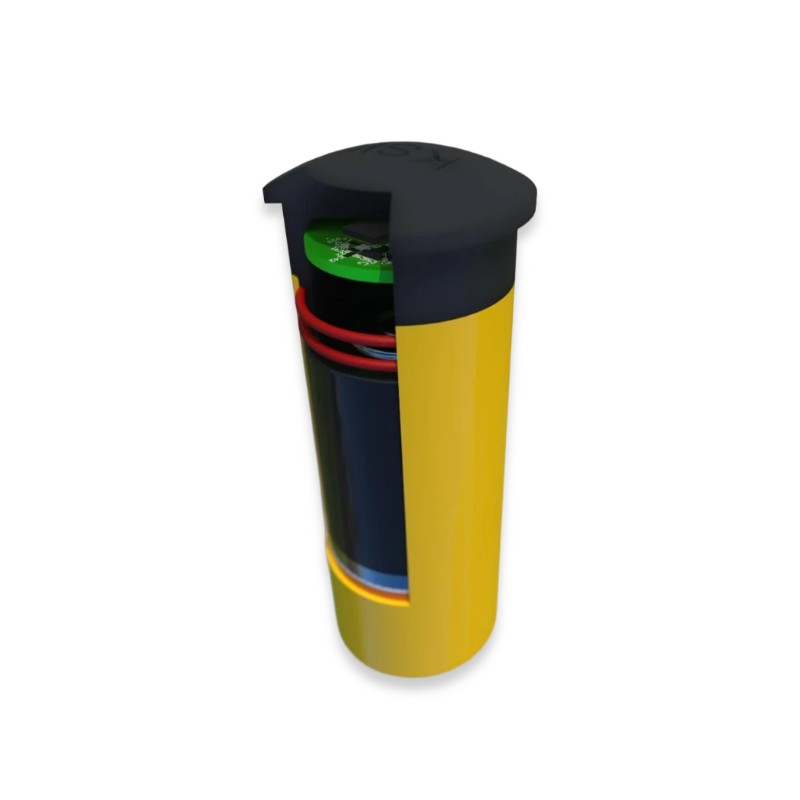
The KSK-150420_P LoRaWAN Parking Sensor detects whether a parking space is occupied. It combines Earth magnetic field measurement with radar and, according to the manufacturer, achieves a detection accuracy of 98 % for cars, trucks and tractor units. After installation, the sensor calibrates itself automatically. It is installed in a 35 mm core-drilled hole in paving stones or road surfaces (at least 80 mm thick) and sealed with bituminous compound.
Technical data
- Detection: magnetometer + radar
- LoRaWAN EU868 (OTAA/ABP)
- Operating temperature: −40 to +80 °C
- Housing: polycarbonate, liquid silicone rubber and stainless steel, IP68, impact resistance equivalent to IK10
- Battery: Li-SOCl₂, 17,500 mAh (size D), field-replaceable; calculated lifetime approx. 10 years at up to 30 events per day
Integration
- Decoder for The Things Stack (TTN/TTI) and ChirpStack with English field names provided by the manufacturer
- Configuration via LoRaWAN downlink
| Equipment | |
|---|---|
| sensors | occupancy, radar |
| antenna | internal |
| Communication | |
| frequency | EU868 |
| connectivity | LoRaWAN |
| Power supply | |
| power supply | battery, included, not replaceable |
| Certifications | |
| enclosure protection class | IP68 |
| Others | |
| Brand | KSK |
The sensor utilizes a dual-detection method combining Pulsed Coherent Radar (PCR) technology and a Tunnel Magnetoresistance (TMR) geomagnetic sensor to ensure high accuracy in monitoring parking space occupancy.
The device is powered by a high-capacity 17.5 Ah Li-SOCl2 battery, which provides a lifespan of at least 5 years with a self-discharge rate of less than 1%.
Yes, the sensor is built for durability with an IEC IP68 protection rating and an enclosure constructed from PBT polycarbonate, LSR, and stainless steel. It is designed to operate in temperatures ranging from -40°C to +80°C.
The device features a detection reporting delay of 17 seconds, allowing for efficient real-time parking load tracking and vehicle guidance.
The sensor is compact, with a height of 80 mm and a diameter of 35 mm, and it weighs approximately 200 grams.
The sensor includes a reed switch that can be triggered externally using a magnet, allowing for a manual reset without needing to disassemble the enclosure.
By default, the device sends a life frame interval every 6 hours to confirm its operational status, though this interval is configurable.